
Biology · Organisms and Populations
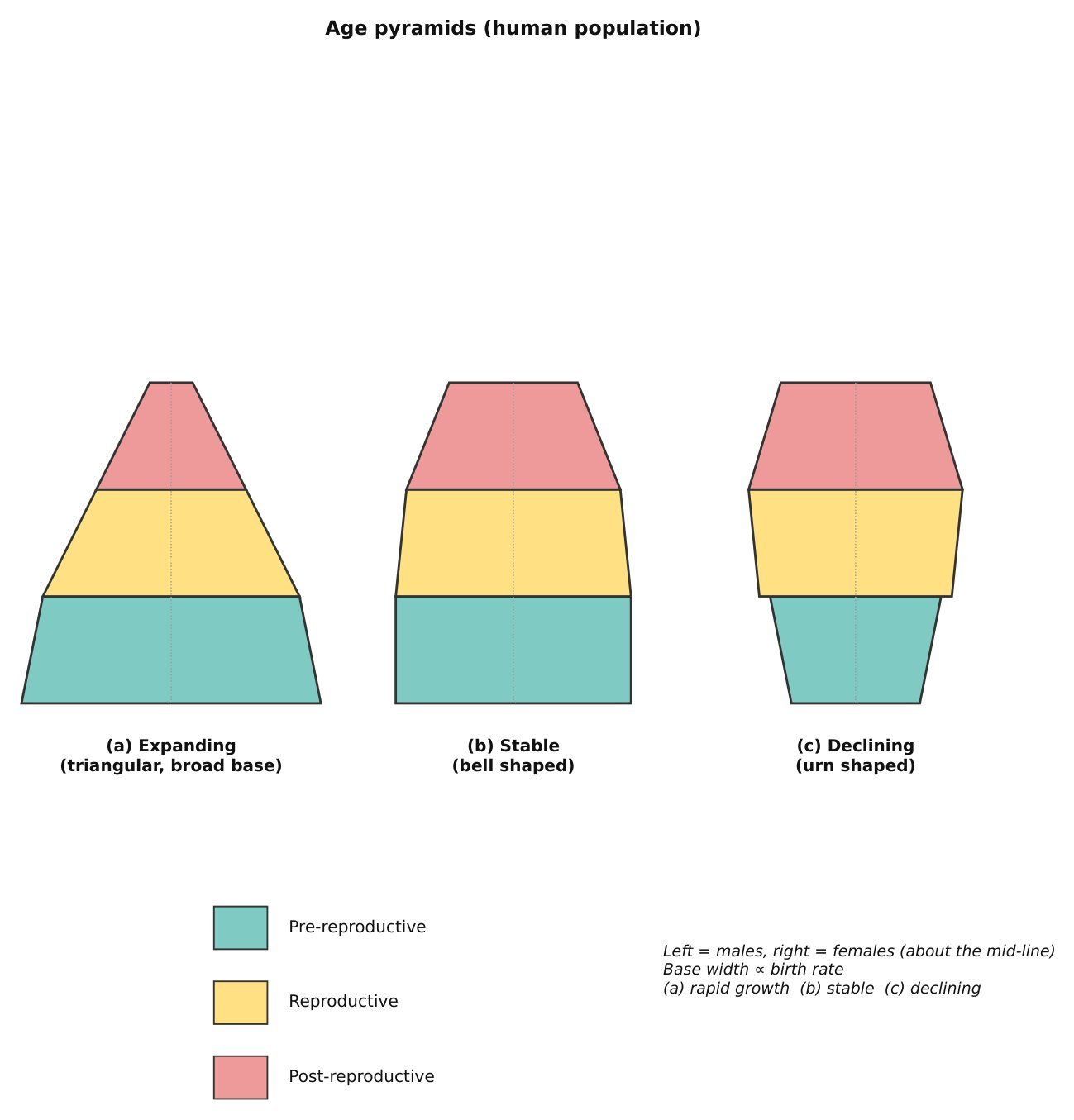
Look at the diagram (Age Pyramids).
 Tap to enlarge
Look at the diagram (Age Pyramids).
Analyze the human age pyramids:
(a) What do the pre-reproductive, reproductive, and post-reproductive age groups represent in an age pyramid?
(b) What does a triangular age pyramid with a very broad base indicate about future population growth?
(c) Differentiate between a stable population age pyramid and a declining population age pyramid.
Tap to enlarge
Try it in your notebook first, then use the hint or steps if you get stuck.
1
Hint 1
(a) Pre-reproductive represents young children/youth, reproductive represents breeding adults, and post-reproductive represents elderly individuals.
2
Hint 2
(b) A broad base indicates a rapidly growing population with high birth rates and a large cohort entering reproductive years.
3
Hint 3
(c) A stable pyramid has roughly equal pre-reproductive and reproductive cohorts (bell-shaped), whereas a declining pyramid has fewer young individuals than adults (urn-shaped with a narrow base). Final answer
(a) Pre-reproductive represents young children/youth, reproductive represents breeding adults, and post-reproductive represents elderly individuals.
(b) A broad base indicates a rapidly growing population with high birth rates and a large cohort entering reproductive years.
(c) A stable pyramid has roughly equal pre-reproductive and reproductive cohorts (bell-shaped), whereas a declining pyramid has fewer young individuals than adults (urn-shaped with a narrow base).
Think first! Each hint opens after 45 seconds, one after another.
Hint: Read the question carefully and write down what is given and what is asked.