
Biology · Sexual Reproduction in Flowering Plants
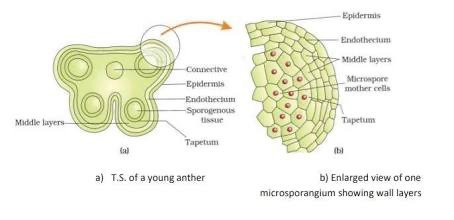
Look at the diagram (T.S. of Young Anther).
 Tap to enlarge
Look at the diagram (T.S. of Young Anther).
Observe the transverse section of a young anther and answer the following:
(a) Name the four wall layers from the outermost to the innermost.
(b) Which specific layer has cells with dense cytoplasm and more than one nucleus? Why are its cells multinucleate?
(c) Which central tissue undergoes meiosis to form microspore tetrads?
Tap to enlarge
Try it in your notebook first, then use the hint or steps if you get stuck.
1
Hint 1
(a) Outermost to innermost: Epidermis → Endothecium → Middle layers → Tapetum.
2
Hint 2
(b) The Tapetum has dense cytoplasm and more than one nucleus (polyploid/multinucleate) due to endomitosis / free nuclear division without cytokinesis, enabling high metabolic activity to nourish pollen.
3
Hint 3
(c) The Sporogenous tissue (located at the center of each microsporangium) undergoes meiosis to form microspore tetrads. Final answer
(a) Outermost to innermost: Epidermis → Endothecium → Middle layers → Tapetum.
(b) The Tapetum has dense cytoplasm and more than one nucleus (polyploid/multinucleate) due to endomitosis / free nuclear division without cytokinesis, enabling high metabolic activity to nourish pollen.
(c) The Sporogenous tissue (located at the center of each microsporangium) undergoes meiosis to form microspore tetrads.
Think first! Each hint opens after 45 seconds, one after another.
Hint: Read the question carefully and write down what is given and what is asked.